

Pickleball is a fun game that you can play in singles or doubles. The scoring might seem complicated, but learning pickleball is easier than other games like tennis. However, you need to remember many things when you begin playing, including the scoring system. As your pickleball skills improve, it gets easier. You can learn how to score in pickleball by following this quick guide.
Is Pickleball Like Tennis?
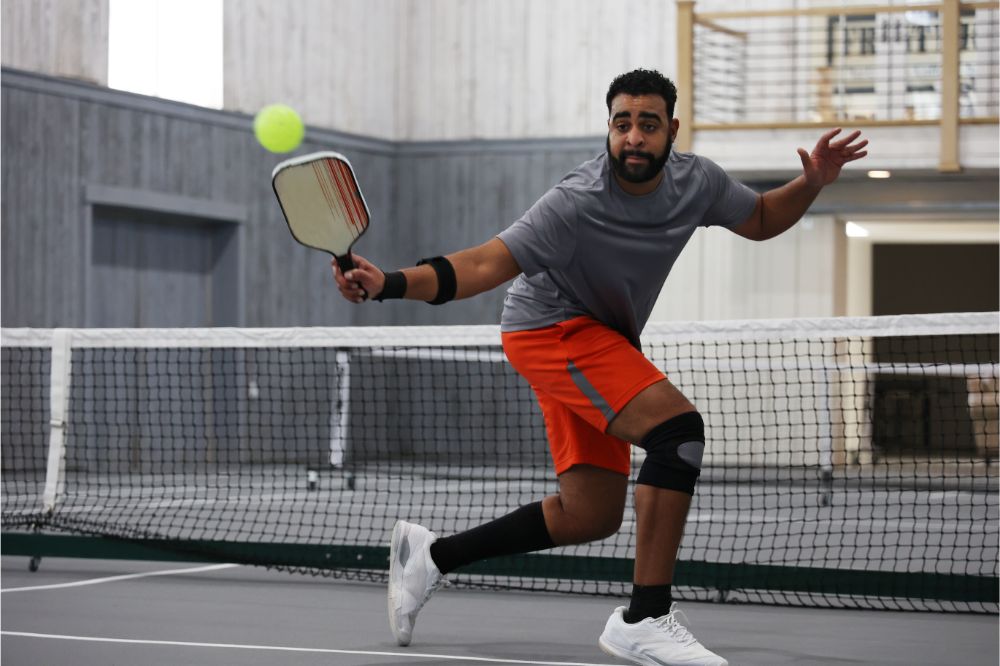
A pickleball game is played indoors or outside, in which two or four players, in turn, hit hollow polymer balls over nets measuring 36″ in height with solid-sided paddles. The two opponents, who are on opposite sides of the net, hit the ball over the net until one side violates the rules. The scoring is different from tennis.
Singles Scoring
Even though there is no second serve, the scoring for both singles and doubles is similar. In the case of an even score, the server serves from the right-hand size, and in the case of an odd score, he serves from the left-hand side. When it comes to the score, it’s the server score that decides the position, not the receiving end. Receivers are positioned according to the score of the server. Server and receiver scores are the terms used to describe the score.
Doubles Scoring
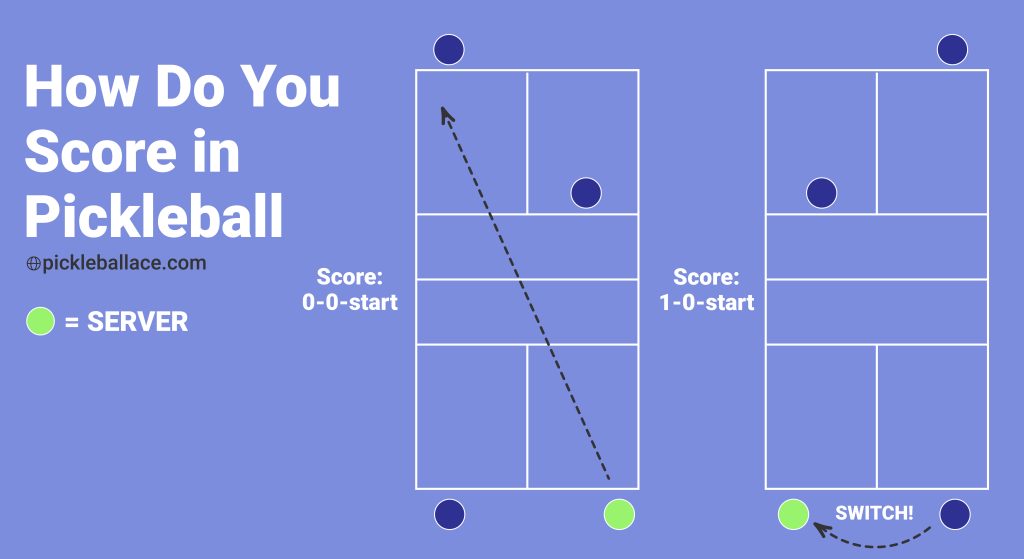
You can only score points when you are on the serving side. The receiving side can’t gain any points. The right-side player serves to the opposing diagonal court as soon as the game begins. As soon as a point is scored, the server goes crosswise to the opponent’s court on the left side. Unless a point is scored, serving players do not change sides. There is no switching of sides on the receiving side.
When starting the serve, the first server is responsible for ensuring the serving team commits no fault. If the serving team commits a fault, the serve is passed to the second server on the team. On losing the serve from the second server, the serve proceeds to the opposing team and is served by the player on the right. Throughout the game, that pattern is repeated.
Calling the Score in a Pickleball Match
There should be three numbers in the current score.
Scores should be called as follows: server scores come first, then the opponent’s score, and when scoring in doubles, the number of the server: 1 or 2 is said. A match will begin with a score of 0 – 0 – 2*
Only one server number (1 or 2) is applicable for that service turn. The player on the right (according to score), the team who ends up with the serve back, is now the first server but only for the service turn. As the game progresses, upon receiving the serve back, it will be the other right-hand player’s first serve for only one turn of that service.
The first server exception*: For the sake of limiting the advantage of serving first, just one player, the right player, receives the first serving turn. The second server becomes that player if the first player misses their serve. As a result, at the beginning of the game, the score should read “0-0-2.” The second server is indicated by the “2,” indicating that once the serve has been lost, it goes to the opposite player.
In games where scores are even, the first server in the match needs to be on the right side, and for odd scores, they are on the left side.
As an alternative, the score should be even for that team if the first server is located on the right side. If this isn’t the case, the players aren’t positioned correctly, or incorrect scores are called.
Keeping Score at the Start of a Pickleball Game
When a match begins, there is only one serve for the team serving. As a result, at the start of the match, the serving team’s right-hand serves across the court diagonally, resulting in 0-0-2 or 0-0-start scores. The third number is two, indicating that the team serving only has one opportunity to serve.
Throughout the game, the team serving gains each point and switches positions, and 1-0-2 or 1-0-start becomes the score when the team who is serving wins, the right side of the court is used to serve! Nevertheless, the opposing team is responsible for a fault if the ball is served into the net. This results in a side-out, with the score set at 0-1 and 1-1 for the other team.
If the opposing team hits a pickleball that enters the net, the left-side play continues to serve. As a result, the score was 0-1-2. A point is scored if the other team can’t catch the ball; it becomes 1-1-2. A second serving is given to the opposing team. What will the score now be if they fail to score another point? 1-1-1. Each team has one point, and the serving team makes the first serves.
Practicing scoring by imagining possible scenarios is another effective way to keep the game going.
Calling the Score in Pickleball
No score should be called in a pickleball game before both servers and receivers have positioned themselves correctly, and everyone is ready to play. If the server or receiver seems to be holding up the match, the score may need to be called.
Pickleball paddles should be raised above your heads if you aren’t ready to hear the score or don’t want the quick server to serve the pickleball before you are ready. After the score is called, the “not ready” signal will be ignored. This is to avoid the game being deliberately held up.
Quick Pickleball Scoring Facts
- Sequential scoring is used (1, 2, 3, 4, etc.)
- Scores can reach 11 points. In some tournaments, they can reach 15 or 21 points.
- The winning team must score at least two points in front. In this case, if there is a score of 10 – 10, the winning team must get at least two more points. The current serving team can only score points.
- There are at least two serves per player per team, except for the first serve, which is just one.
- You score a point when your competitor fails to return the ball successfully.
- Your partner switches sides as soon as you score a point, and you serve again.
- You continue serving and scoring points as long as your team does not miss a shot.
- Serving must always be preceded by the score being announced by the server.
- Don’t start the game until the scores have been called.
Conclusion
Along with socializing, pickleball provides a great opportunity for competitive play. What good is competition if you don’t keep score? The game becomes more interesting when you know how to keep score in pickleball. Practicing is the key to success!
Make up an advanced pickleball strategy scoring system that you can easily follow to help you learn how the scoring process works. Many beginner players find this helps. You can try the pickleball video lesson collection online with tutorials for learning the scoring basics. Looking at scoring examples can help you learn how to do it.
Talk to others pickleball players about how they learned, and they might have some tips and tricks to make the whole process a lot easier for you. It migh seems confusing at first, but it is easy once you grasp the technique.